Celtic Cross Tarot Spread — 10 Cards, Full Picture
The Celtic Cross is the most widely used tarot spread in the world. Ten cards, ten positions — each one answers a different part of your question. It covers where you are now, what's blocking you, what's behind you, and where things are heading.
What is the Celtic Cross Spread?
The Celtic Cross tarot dates back to the early 20th century and the Order of the Golden Dawn. Arthur Edward Waite popularized it alongside the Rider-Waite tarot deck, and it became the standard 10 card spread layout for detailed readings.
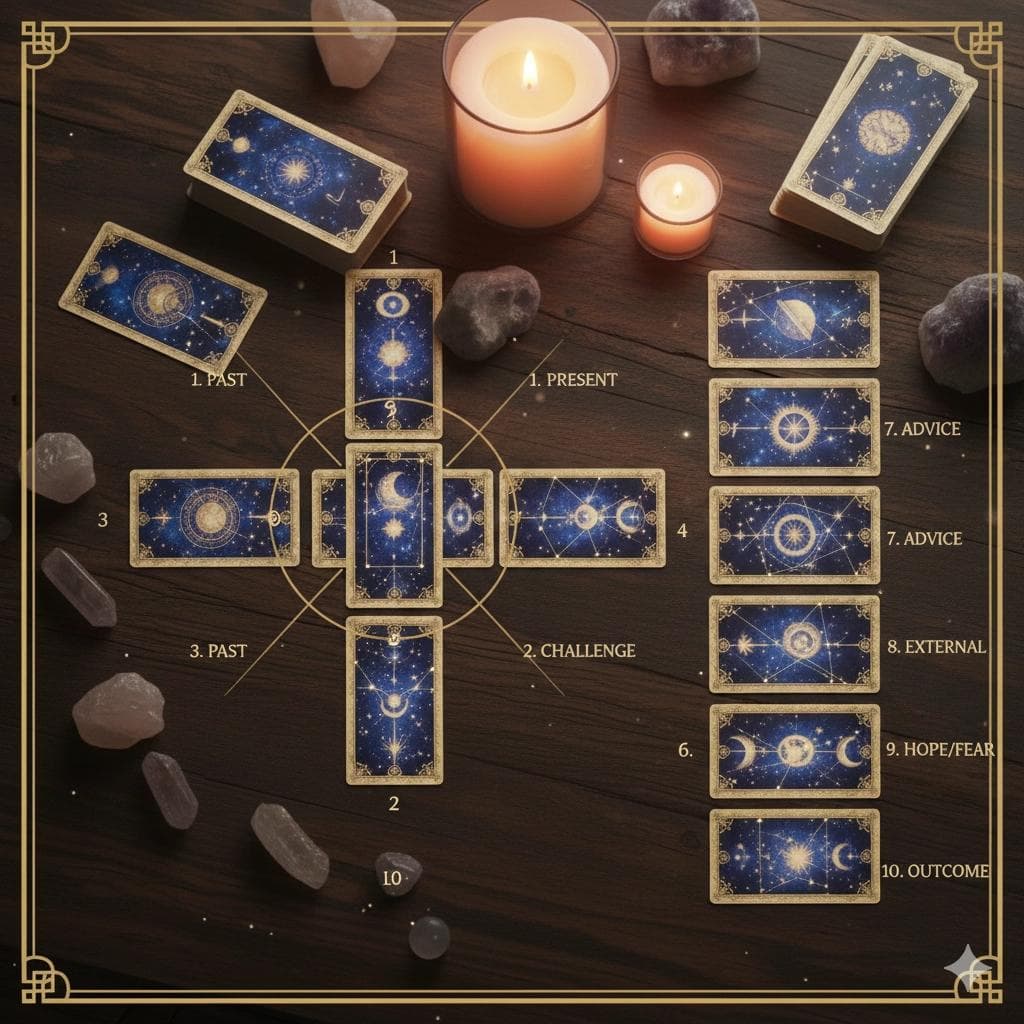
The tarot layout uses 10 cards arranged in two groups: a cross of 6 cards on the left and a staff of 4 cards on the right. The cross explores your current situation from every angle. The staff shows the forces around you and where things are likely to land.
It works best for complex questions — career crossroads, relationship shifts, or life decisions with multiple factors. For simpler questions, a Three Card Spread gives faster answers.
The 10 Card Positions
Each position in the Celtic Cross asks a specific question. Here's what each one tells you:
The Cross (Cards 1–6)
- The Present — Your current situation. The core energy around your question right now.
- The Challenge — What's crossing you. The main obstacle or influence you're dealing with. This card is placed sideways over Card 1.
- The Foundation — The root cause. What created the current situation — sometimes conscious, sometimes not.
- The Recent Past — What's fading. Energy that's leaving your life but still has influence.
- The Best Outcome — What's possible. The best realistic result given your current path.
- The Near Future — What's coming next. The energy approaching in the short term.
The Staff (Cards 7–10)
- Your Attitude — How you see yourself in this situation. Your inner feelings, fears, or expectations.
- External Influences — The people and environment around you. How others affect the outcome.
- Hopes and Fears — What you want and what you're afraid of. These are often two sides of the same coin.
- The Outcome — The most likely result if things continue as they are. Not fixed — your actions can change it.
How to Lay the Celtic Cross
Prepare
Shuffle your deck while holding your question in mind. When you feel ready, cut the deck and draw 10 cards face-down.
Place the Cross
- Card 1 goes in the center (present).
- Card 2 goes horizontally across Card 1 (challenge).
- Card 3 goes below the center (foundation).
- Card 4 goes to the left (recent past).
- Card 5 goes above the center (best outcome).
- Card 6 goes to the right (near future).
Place the Staff
Starting from the bottom and working up on the right side:
- Card 7 at the bottom (your attitude).
- Card 8 above it (external influences).
- Card 9 above that (hopes and fears).
- Card 10 at the top (outcome).
Flip each card one at a time. Read it in context of its position before moving on.
Tips for Reading the Celtic Cross
Read the Cross First
Cards 1 and 2 are the heart of the reading. They tell you exactly what's happening and what's in the way. Everything else builds on this pair.
Look for Patterns
Notice repeating suits, numbers, or themes across the 10 cards. Three Cups cards? Emotions are central. Multiple Major Arcana? Big life forces are at play.
The Outcome Isn't Fixed
Card 10 shows the most likely result, not a certainty. Cards 7–9 show what you can influence. Change your approach, and the outcome can shift.
When to Use the Celtic Cross
The Celtic Cross works best when:
- You have a complex question with multiple factors at play
- You want to understand both the situation and the people involved
- You're at a crossroads and need to see the full landscape before deciding
- You want a detailed reading rather than a quick answer
It's not ideal for:
- Simple yes/no questions — try a Yes/No Reading instead
- Daily guidance — a single card draw is faster and more focused
- Your first-ever reading — start with the Three Card Spread to build confidence
How to Do Your First Celtic Cross Spread Reading
Write Down Your Question
Be specific. "What do I need to know about my career change this spring?" gives better results than "What about my job?" Write it down so you can refer back to it as you read.
Shuffle and Lay 10 Cards
Shuffle while thinking about your question. Draw 10 cards and place them face-down in the Celtic Cross pattern: 6 cards in the cross, 4 in the staff on the right.
Read the Cross (Cards 1–6)
Flip Cards 1 and 2 first — they're the core. Then flip 3–6 one at a time. For each card, read its meaning in context of that position's question.
Read the Staff (Cards 7–10)
Flip Cards 7 through 10 from bottom to top. These show external forces, your mindset, and the likely outcome. Connect them back to what the cross revealed.
Frequently Asked Questions
How many cards are in the Celtic Cross spread?
Ten cards. Six form the tarot spread cross pattern (covering your situation, challenge, foundation, past, best outcome, and near future). Four form the staff on the right (your attitude, external influences, hopes/fears, and the final outcome).
Is the Celtic Cross good for beginners?
It's more advanced than a Three Card Spread, but beginners can use it with a reference guide. The key is understanding what each position asks before you try to interpret the card in it. Start with simpler spreads first, then try the Celtic Cross when you're comfortable with card meanings.
How often should I do a Celtic Cross reading?
Give each reading time to play out — once a month on the same question is a good rhythm. If you pull 10 cards every day on the same topic, the answers get muddled. Use daily card draws between Celtic Cross readings.
What if most cards are reversed in my Celtic Cross?
Many reversed cards suggest blocked or internalized energy across the situation. It doesn't mean the reading is negative — it means the energies involved need attention, patience, or a different approach. Read each reversed card in its position context.
Can I use the Celtic Cross for yes/no questions?
You can, but it's overkill. The Celtic Cross gives nuanced, layered answers. For a direct yes/no, use a simpler method — a single card or Yes/No Reading technique is more efficient.
What's the difference between the Celtic Cross and other 10-card spreads?
The Celtic Cross has a specific layout — a central cross with a vertical staff. Other 10-card spreads may use rows, circles, or trees. The Celtic Cross positions are designed to show your situation from every angle: internal, external, past, future, and the forces at work.