Four of Swords — Rest, Recovery, and Mental Retreat
Suit: Swords (Air) Number: 4 Element: Air Keywords: Rest, recovery, contemplation, retreat, meditation, mental peace, timeout, healing, stillness
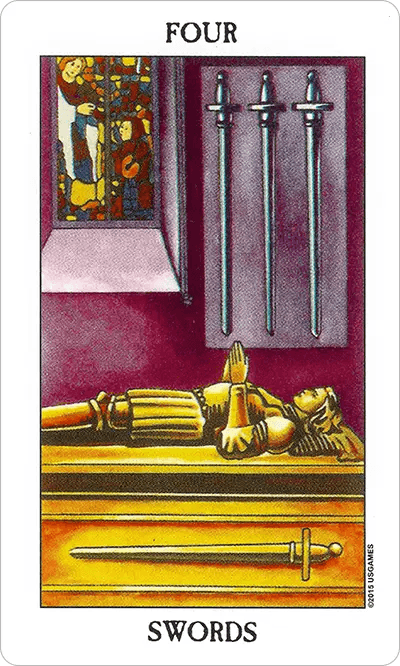
The Four of Swords shows a figure lying in stillness, hands folded in prayer or meditation, resting beneath the shelter of a church or sacred space. Three swords hang on the wall above, while a fourth lies beneath the resting figure. The scene is quiet. Peaceful. Still.
This is the card of necessary rest. After the heartbreak of the Three of Swords comes the Four — the moment when you stop fighting, stop thinking, and simply rest. This card represents retreat from the world, time taken to recover, and the wisdom of knowing when to pause.
The Four of Swords isn't about giving up. It's about strategic withdrawal. Stepping back to heal. Taking time to think. Creating space for your mind and body to recover before you re-engage with the world.
Symbolism on the Card
The Rider-Waite-Smith Four of Swords contains imagery that reveals its contemplative meaning:
The Resting Figure — A person (often a knight) lies flat on their back in a position resembling sleep, death, or deep meditation. This represents complete stillness, surrender, and the necessity of rest. The figure isn't collapsed from exhaustion — they've chosen to lie down. This is deliberate rest.
The Praying Hands — The figure's hands are positioned in prayer, suggesting spiritual contemplation, meditation, or the mental work that happens in stillness. Even while resting, there's an element of mindfulness and intentionality.
The Sacred Space — The scene takes place in what appears to be a church or monastery, indicated by stained glass windows in the background. This represents sanctuary — a safe space to retreat from the world. Rest is sacred. Recovery requires protection.
The Three Swords on the Wall — Three swords hang suspended above the figure, representing past conflicts, worries, or mental battles that have been temporarily set aside. They're still present, but they're not active. You haven't solved the problems — you've just stopped fighting them for now.
The Fourth Sword — One sword lies horizontally beneath the resting figure, parallel to their body. This represents the mental energy or conflict that you're currently processing while you rest. Even in stillness, some integration is happening.
The Stained Glass Window — A window often showing a figure giving blessing appears in some versions. This suggests divine support, healing energy, or the idea that rest itself is blessed. Recovery is holy work.
The Golden Background — The warm, glowing color suggests that despite the stillness, there's healing happening. This isn't depression or collapse — it's restorative rest.
Four of Swords Upright — Time to Rest
When the Four of Swords appears upright in a reading, it's a clear message: rest. You need a break. Your mind needs quiet. Your body needs recovery. This card appears when you've been pushing too hard, thinking too much, or fighting battles (internal or external) that have drained you.
The Four of Swords upright isn't suggesting you're weak or lazy — it's recognizing that humans need rest to function. Mental exhaustion is real. Decision fatigue is real. And continuing to push when you need a break leads to burnout, not achievement.
This card can indicate actual physical rest (sleep, taking time off, vacation), mental rest (meditation, stepping away from problems temporarily), or emotional rest (retreat from relationship drama, social obligations, or demanding situations).
Core upright meanings:
- Rest and recovery — Taking necessary time off to restore energy
- Mental retreat — Stepping away from overthinking and mental chaos
- Contemplation — Quiet time for reflection and integration
- Meditation — Practices that calm the mind and restore clarity
- Timeout — Pausing conflict or difficult situations temporarily
- Healing — Recovering from mental or physical exhaustion
- Strategic withdrawal — Pulling back not from weakness, but from wisdom
The Four of Swords asks: When was the last time you truly rested? What would happen if you stopped pushing and just let yourself be still? What clarity might come from quiet?
This card reminds you that rest is productive. Some problems can only be solved by stepping away from them. Some healing only happens in stillness.
Four of Swords Reversed — Restlessness or Burnout
The Four of Swords reversed can indicate two different challenges:
1. Inability to Rest or Restlessness
The reversed Four often shows that you can't rest even when you need to. You're exhausted but can't sleep. You took time off but your mind won't stop racing. You desperately need a break but guilt, anxiety, or external pressure keeps you going.
Signs of blocked rest:
- Insomnia or poor quality sleep despite exhaustion
- Guilt when trying to rest ("I should be doing something")
- Mind racing even during attempted downtime
- Inability to step away from work or problems
- Restlessness during meditation or quiet time
2. Stagnation or Too Much Withdrawal
The reversed Four can also indicate that rest has turned into avoidance. You're not recovering — you're hiding. What started as necessary retreat has become isolation. You're stuck in stillness and afraid to re-engage with life.
Signs of excessive withdrawal:
- Depression or lethargy masquerading as "rest"
- Avoiding life indefinitely under the guise of self-care
- Fear of returning to normal activity
- Using "I need rest" to dodge responsibilities or challenges
- Isolation that's deepening rather than healing
Which meaning applies? Look at the context. If you've been pushing hard, the reversed Four warns you're burning out and can't rest properly. If you've been withdrawn for a long time, it suggests you're stuck in retreat and need to gently re-engage.
The Four of Swords reversed asks: Can you not rest, or can you not stop resting? What's blocking true recovery?
Four of Swords in Love and Relationships
Upright in Love:
The Four of Swords in a love reading suggests taking space in a relationship. This isn't necessarily a breakup — it's a conscious decision to pause, step back, or take a break to think clearly. You or your partner might need time alone to process emotions, gain perspective, or simply rest from relationship intensity.
For couples, this card can indicate a needed pause in conflict. You've been arguing or dealing with heavy issues, and it's time to table the conversation temporarily. Not to avoid it, but to rest before returning to it with fresh energy.
For singles, the Four of Swords suggests intentionally not dating for a while. You're taking a break from romance to focus on yourself, heal from past relationships, or simply enjoy solitude. This is healthy, not avoidant.
The Four asks: Does this relationship need breathing room? Are you exhausted from relationship conflict and need a timeout? What would clarity look like if you stepped back temporarily?
Reversed in Love:
The Four of Swords reversed in love can mean you're unable to take the space you need. You know the relationship is draining you, but you can't bring yourself to ask for a break. Or you're so anxious about the relationship that you can't rest even when you have time apart.
Alternatively, this card can indicate that separation has gone on too long. What was meant to be a brief break has become indefinite distance. Someone needs to re-engage.
For singles, the reversed Four can suggest anxiety about dating that prevents you from enjoying being single, or the opposite — staying withdrawn from romance longer than is healthy.
The reversed Four asks: Are you getting the space you need, or are you stuck in separation? Is the break serving the relationship, or is it becoming avoidance?
Four of Swords in Career and Finances
Upright in Career:
The Four of Swords is a strong signal to take time off work. This might be vacation, a sabbatical, sick leave, or just actually using your PTO. You've been pushing hard, and your mind needs rest. This card can appear when you're approaching burnout and need to step away before you collapse.
This card also favors contemplative work — research, planning, strategy, or solo projects that don't require intense collaboration or performance. It's a good time for thinking, not doing.
The Four of Swords can indicate putting a project on hold, taking a break from job searching, or intentionally slowing down your career pace to avoid exhaustion.
Upright in Finances:
Financially, the Four of Swords upright suggests a period of financial rest — not making major purchases, avoiding risky investments, or taking a break from actively pursuing new income streams. This is a time to pause and let your finances stabilize.
This card can also indicate needing to rest from financial stress. Sometimes the best financial decision is to stop obsessing about money and trust that you've done what you can.
Reversed in Career:
The Four of Swords reversed in career contexts warns of burnout or inability to take needed breaks. You know you need time off, but you can't bring yourself to take it. Work anxiety follows you on vacation. You're exhausted but feel guilty resting.
This card can also indicate returning to work after time off, or realizing that extended leave has become stagnation and you need to re-engage.
Reversed in Finances:
Financially, the reversed Four can indicate anxiety about money that prevents rest, or the opposite — avoiding financial reality by "resting" from dealing with necessary money management.
Four of Swords' Spiritual Meaning
Spiritually, the Four of Swords represents the sacred pause — the deliberate choice to step back from activity and enter contemplative stillness. Many wisdom traditions emphasize the importance of retreat, meditation, and solitude for spiritual growth.
This card appears when your spiritual practice needs to shift toward quietness and inward focus. You might need a meditation retreat, time away from community obligations, or simply permission to stop doing and start being.
The Four of Swords teaches that stillness is not emptiness. In fact, some of the deepest spiritual work happens when we stop striving and simply rest in awareness. Prayer, meditation, contemplation — these are the practices of the Four of Swords.
Spiritually, this card asks:
- What would happen if I stopped seeking and simply rested in presence?
- Do I trust that spiritual growth can happen through stillness, not just action?
- What needs to be integrated from my recent experiences?
- Can I honor rest as a sacred practice rather than a guilty pleasure?
The Four of Swords reminds us that the spiritual path includes valleys of quiet rest, not just mountain peaks of revelation.
Questions to Ask When You Draw the Four of Swords
The Four of Swords invites reflection on rest, recovery, and the wisdom of pausing. When this card appears, consider:
- Am I actually resting, or am I just collapsing from exhaustion?
- What would true rest look like for me right now?
- What am I afraid will happen if I stop and rest?
- Do I give myself permission to pause, or do I feel guilty when I'm not productive?
- What clarity might come if I stepped away from this situation temporarily?
- Am I avoiding rest, or am I stuck in too much withdrawal?
- What needs to be integrated or processed during this quiet time?
- How can I make rest sacred rather than seeing it as laziness?
The Four of Swords teaches that rest isn't weakness — it's wisdom. Knowing when to step back is as important as knowing when to push forward.