The Hierophant — Tradition, Teaching, and Sacred Knowledge
Number: V (5)
Element: Earth
Planet: Venus
Zodiac: Taurus
Keywords: Tradition, conformity, spiritual wisdom, institutions, guidance, teaching, ritual, conventional beliefs, mentorship
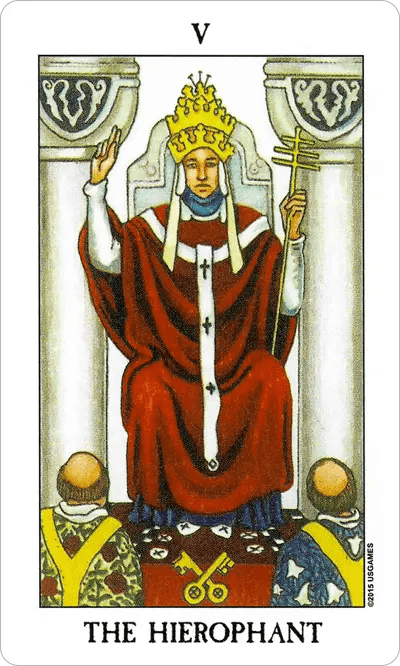
The Hierophant sits on a throne between two pillars, wearing the triple crown of spiritual authority. He holds a papal cross staff and makes a blessing gesture. Two acolytes kneel before him. Crossed keys lie at his feet — symbols of spiritual knowledge and the mysteries.
This is the card of tradition, teaching, and established wisdom. Where The High Priestess represents personal, intuitive knowledge, The Hierophant represents organized religion, traditional teachings, and wisdom passed through institutions — the priest, teacher, and mentor bridging divine truth and human understanding.
He asks you to honor tradition and consider the value of established paths.
Symbolism on the Card
The Rider-Waite-Smith Hierophant card is rich with religious and institutional symbolism:
The Triple Crown — The three-tiered papal crown represents the three worlds (physical, emotional, mental) or the three aspects of divinity (Father, Son, Holy Spirit). The Hierophant has authority across all realms and serves as intermediary between heaven and earth.
The Triple-Crossed Staff — Also called the papal cross, this staff with three horizontal bars represents the same three-tiered authority. The Hierophant carries the weight of tradition and the responsibility of spiritual leadership.
The Two Pillars — Like The High Priestess, The Hierophant sits between two pillars representing duality, balance, and the gateway to sacred space. But where her pillars frame mystery, his frame established doctrine.
The Blessing Gesture — His right hand is raised in blessing, two fingers pointing up (toward heaven), two pointing down (toward earth). This echoes The Magician's "as above, so below" but through the lens of religious tradition rather than personal power.
The Crossed Keys — Two keys (one gold, one silver) crossed at his feet represent the keys to the kingdom of heaven — access to spiritual knowledge, mysteries, and sacred teachings. The Hierophant holds (and grants) access to wisdom.
The Two Acolytes — Two students kneel before him, representing the passing of knowledge from teacher to student. The Hierophant's role is to teach, guide, and initiate others into sacred traditions.
The Red and White Roses — Decorating the acolytes' robes, red roses (passion, life) and white lilies (purity, spirit) represent the balance of earthly and spiritual devotion. The Hierophant teaches integration of both.
The Gray Pillars — Unlike The High Priestess's stark black and white, The Hierophant's pillars are gray — suggesting compromise, established middle ground, and accepted tradition rather than mystery.
The Hierophant Upright — Honor Tradition and Seek Guidance
When The Hierophant appears upright in a reading, it signals tradition, conventional approaches, spiritual guidance, education, and conformity to established systems. This is the card that says: don't reinvent the wheel. Learn from those who came before. Follow the proven path.
The Hierophant upright asks: What wisdom already exists that I can learn from? Who can guide me? What traditions or systems provide structure and meaning?
This card appears when you're seeking a teacher, joining an institution, following traditional paths, or learning established knowledge. The Hierophant reminds you that not everything needs to be discovered from scratch — sometimes the old ways work because they've been tested through centuries.
Core upright meanings:
- Traditional values and beliefs — Following established norms, conventional wisdom, cultural traditions
- Spiritual guidance and teaching — Seeking a mentor, guru, teacher, or spiritual leader
- Institutions and organizations — Churches, schools, corporations, traditional structures
- Conformity — Fitting in, following the rules, doing what's expected
- Education — Formal learning, degrees, certifications, established curricula
- Ritual and ceremony — Weddings, religious rites, formal traditions
The Hierophant upright often appears when you're getting married (traditional ceremony), returning to religious practice, seeking therapy or counseling, pursuing formal education, or joining an established organization.
The Hierophant isn't about blind obedience — it's about recognizing that tradition exists because it works. Some wisdom has been tested and refined over generations. Sometimes the conventional path is conventional because it's effective.
The Hierophant Reversed — Questioning Authority and Breaking Convention
The Hierophant reversed typically signals rebellion against tradition, unconventional paths, or problems with institutions:
1. Challenging Tradition and Rejecting Conformity
The most common meaning of the reversed Hierophant is breaking free from traditional expectations. You're questioning the rules, challenging authority, or choosing an unconventional path. You're not interested in doing things "the way they've always been done."
Signs of rebellious Hierophant energy:
- Leaving organized religion to forge your own spiritual path
- Choosing unconventional relationship structures (open relationships, child-free by choice, etc.)
- Challenging outdated traditions or rules
- Pursuing alternative education or self-directed learning
- Rejecting career paths your family or culture expects
2. Personal Spirituality Over Organized Religion
The reversed Hierophant often represents choosing direct spiritual experience over institutionalized belief. You're connecting with the divine on your own terms, without intermediaries or established doctrine.
This isn't necessarily rejecting spirituality — it's rejecting the structure around it.
3. Restrictive or Corrupt Institutions
The reversed Hierophant can also warn that traditions or institutions are too rigid, outdated, or even harmful. The system that's supposed to guide you is actually limiting you. The teacher who should empower you is controlling you.
Signs of problematic Hierophant energy:
- Dogmatic thinking that doesn't allow questions
- Institutions prioritizing rules over people
- Spiritual or educational abuse
- Corruption within traditional systems
- Being trapped by "shoulds" and expectations
Which meaning applies? If the question involves personal freedom or authenticity, the reversed Hierophant suggests breaking free is healthy. If it's about connection or guidance, the reversed Hierophant might suggest you're rejecting wisdom you actually need.
The Hierophant reversed asks: Am I honoring my authentic path, or rebelling just to rebel? Are the traditions I'm following still serving me, or have they become restrictive?
The Hierophant in Love and Relationships
Upright in Love:
The Hierophant in a love reading signals traditional, committed relationships — engagements, marriages, partnerships following conventional timelines and structures. If you're single, this card suggests meeting someone through traditional channels (religious organizations, work, social networks) or someone who values commitment and stability.
In an existing relationship, the upright Hierophant represents making it official — getting engaged, married, or otherwise formalizing the commitment. This is also the card of couples counseling, relationship guidance, or seeking advice from mentors.
The Hierophant in love values commitment, shared values, cultural or religious compatibility, and building a relationship on tried-and-true foundations.
The Hierophant asks: Are we aligned in our values and beliefs? Are we ready to commit publicly and formally? What traditions or guidance can strengthen our bond?
Reversed in Love:
The Hierophant reversed in love signals unconventional relationships or questioning traditional relationship structures. You might be in (or seeking) a non-traditional partnership — open relationship, age-gap romance, interfaith partnership, or simply choosing not to marry.
The reversed Hierophant can also indicate:
- Conflict over differing values or beliefs
- One partner wanting commitment while the other resists
- Families or communities not approving of the relationship
- Choosing personal connection over social expectations
Alternatively, the reversed Hierophant can warn that you're staying in a relationship because it's "what you're supposed to do" — not because it genuinely fulfills you.
The reversed Hierophant asks: Are we together because we want to be, or because it's expected? Can we honor our authentic connection, even if it doesn't look traditional?
The Hierophant in Career and Finances
Upright in Career:
The Hierophant is a strong card for traditional career paths, formal education, and working within established institutions. It appears when you're pursuing degrees or certifications, working in corporate structures, teaching, joining professional organizations, or following conventional career advancement.
The Hierophant represents careers in education, religion, counseling, law, medicine, or any field requiring formal training and credentials. It's the card of working within the system, following established protocols, and respecting hierarchies.
This card says: get the degree. Earn the credentials. Learn from masters in your field. Build credibility through traditional means.
Upright in Finances:
Financially, the upright Hierophant suggests conservative, traditional financial approaches — working with financial advisors, following established investment strategies, or saving through conventional methods (401k, savings accounts, traditional portfolios).
The Hierophant doesn't take financial risks — he builds wealth slowly, methodically, through proven strategies.
Reversed in Career:
The Hierophant reversed in career readings signals non-traditional career paths — entrepreneurship, freelancing, creative work, or careers that don't require formal credentials. You're either choosing to work outside the system or struggling within traditional corporate structures.
This card can also indicate:
- Conflict with authority figures or rigid workplace cultures
- Rejecting the conventional career path expected of you
- Self-education rather than formal degrees
- Working in emerging or unconventional fields
Reversed in Finances:
Financially, the reversed Hierophant suggests alternative financial strategies — cryptocurrency, non-traditional investments, or rejecting conventional financial advice. This can be innovative or risky, depending on context.
The reversed Hierophant can also warn against blindly following financial "experts" who don't have your best interests at heart.
The Hierophant's Spiritual Meaning
Spiritually, The Hierophant represents organized religion, spiritual teachers, and the transmission of sacred knowledge through lineages and traditions. While The High Priestess represents direct, mystical knowing, The Hierophant represents wisdom preserved and passed down through generations.
The Hierophant teaches that spiritual traditions exist for a reason. Rituals, practices, and teachings have been refined over centuries. There's value in learning from those who walked the path before you.
When the Hierophant appears in a spiritual reading, it suggests:
- Seeking a spiritual teacher — Find a mentor, guru, priest, or guide
- Joining a spiritual community — Church, sangha, coven, or practice group
- Honoring tradition — Explore your ancestral spiritual practices or established religions
- Formal spiritual training — Study sacred texts, complete initiations, or commit to a lineage
The Hierophant reminds you that you don't have to figure everything out alone. Spiritual wisdom already exists. Teachers are available. Traditions can provide structure and guidance for your path.
However, The Hierophant also warns: don't mistake the form for the essence. Don't get so caught up in rules and rituals that you forget why they exist. The map is not the territory. The tradition should serve your spiritual growth, not limit it.
Questions to Ask When You Draw The Hierophant
The Hierophant invites reflection on tradition, guidance, and conformity. When this card appears in your reading, consider these questions:
- What wisdom or guidance already exists that I'm ignoring?
- Who can teach or mentor me in this area?
- Am I following tradition because it serves me, or because I'm afraid to break the rules?
- What established systems or structures can support my goals?
- Where am I rebelling just to rebel, rather than honoring my authentic path?
- What values and beliefs truly matter to me?
- Am I seeking approval or following my truth?
- How can I honor both tradition and innovation?
The Hierophant doesn't ask you to blindly conform or rigidly rebel. He asks you to thoughtfully consider what traditions serve you and what wisdom you can learn from those who came before.